Nine worlds. One evidence layer.
Clinical Trial Radar sits between authoritative public records and the people making high-stakes decisions. It plans the research, checks the live record, and shows which source each statement came from. Scroll through the worlds it serves.
Study searches run against the live registry, and answers carry inline citations.
It explains what a record means, in plain language, in your language.
No account, no ads, no sale or sharing of contact data — and consent before any health answer.
01 — Patients & caregivers
Understand your options tonight.
1:04 a.m. A new diagnosis, a progression, a standard of care that has run out — and a registry written for researchers.
Trial Radar turns that search into something a family can follow: plain language, sources attached, nothing to sign up for.
- Ask in your own words, or filter by condition, treatment, phase and recruiting status — then sort study sites by distance.
- Read any study, term or eligibility criterion explained in plain language, with the original text one tap away.
- Prepare with Eligibility Questions in the Participation Assistant, which starts only after you give explicit consent.
- Save studies, compare up to five side by side, and print a clean packet for the appointment.
- Share a conversation with family through a link that expires after 30 days unless you renew it, and get e-mail alerts when a study changes.
Trial Radar explains eligibility criteria in plain language and helps you prepare questions. It does not determine whether you qualify — only the study team can do that.
Original wording
Adequate hepatic function, defined as total bilirubin ≤ 1.5 × ULN.
In plain language
A blood test measures bilirubin, a substance your liver helps clear. This study requires a result no more than 1.5 times the lab’s upper limit of normal.
02 — Clinicians
Four minutes to a defensible shortlist.
The patient asks about experimental options. The appointment has four minutes left.
Trial Radar does the reading first, then shows its work so you can check it.
- Combine structured filters with natural-language search; study searches run against the live ClinicalTrials.gov API, not model memory.
- Read criteria rewritten in plain language beside the original registry text.
- In Advanced mode, turn the study's own criteria into a Clinician Checklist — a preparation aid, not an eligibility decision.
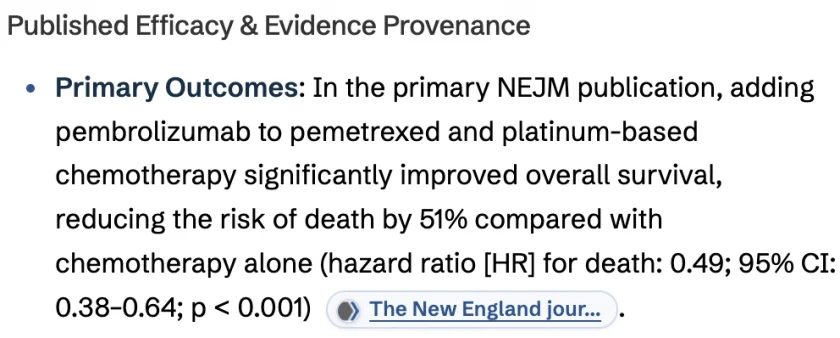
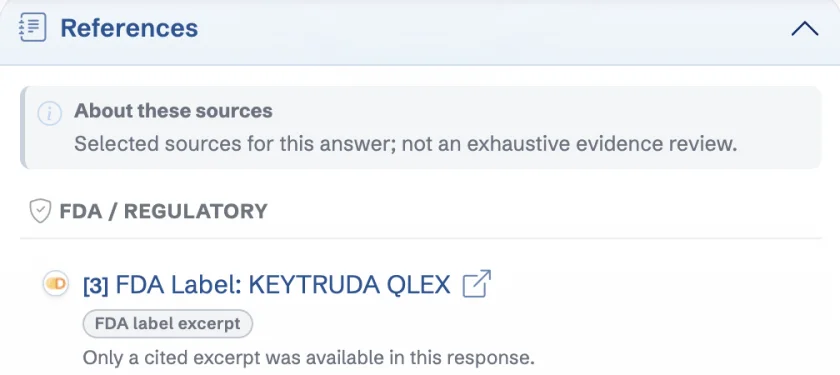
- Open inline citations to the registry record, PubMed literature and FDA labels — with a plain statement that the sources shown are not exhaustive.
03 — Research coordinators & site teams
Conversations that start informed.
Protocol surprises tend to surface at the first visit — the travel, the procedures, the washout period.
When candidates can read a protocol's demands before they call, the first conversation can start further along. Trial Radar is designed for exactly that preparation.
- Visit schedules, procedures and timelines explained in plain language.
- Inclusion and exclusion criteria readable at home, with the registry text alongside.
- Printed question lists that candidates bring to the call.
- Site locations, contacts and maps taken from the registry record.
Trial Radar does not screen, refer or enroll candidates, and does not sell or share their contact details.
- How many visits happen in the first month, and where?
- Would I need to stop a current medication, and for how long?
- Which procedures are part of the study, beyond my usual care?
- Are travel or parking costs covered?
04 — Advocacy organizations
A resource you can recommend with confidence.
Your members trust you with their hardest questions. Whatever you link to carries your name.
Trial Radar is built to deserve that trust, by design rather than by promise.
- Free for patients, caregivers and clinicians, with no account.
- No ads, and no sale or sharing of contact data.
- Health answers processed only after explicit, revocable consent.
- 13 languages, so one resource works across your whole community.
- Co-branded, condition-focused hubs available through a partnership.
- Every core feature works without sign-up
- Answers cite the registry, literature and FDA data
- Consent before any health answer; End requests deletion
- Keyboard, screen-reader and right-to-left support
05 — Global & multilingual communities
In your language, by default.
ClinicalTrials.gov records are written in English. Most of the world's patients read another language first.
- 13 languages across 16 locales, including full right-to-left Arabic and Hebrew.
- Condition and treatment terms localized by real-world usage, not translated literally on the fly.
- AI-assisted study-title translation in the reader's language.
- Distance units, dates and typography that follow local conventions.
- Studies in 220+ countries and all 50 U.S. states.
06 — Researchers, educators & health journalists
Every sentence, sourced.
A fluent paragraph about a trial is easy to produce. One you can cite is not.
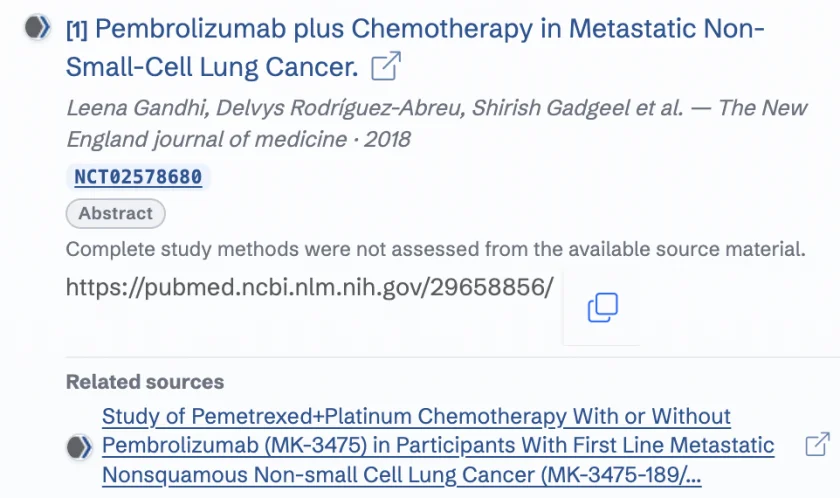
- Registry, literature and FDA label context assembled into one answer.
- Literature ranking that weighs publication type — systematic reviews, guidelines, randomized trials.
- Provenance labels that describe what source material was available — factual provenance, never a quality grade.
- Save answers, share whole conversations or single answers, and print with citations intact.
07 — Biopharma sponsors & CROs
Make every study readable, everywhere.
Recruitment slips when people can't find a protocol — or can't read it in their language.
Trial Radar makes a sponsor's registered studies discoverable and understandable from day one, with no localization project on your side.
- 1,000+ sponsor and organization portals, read live from the registry so they don't go stale.
- AI organization overviews, with citations.
- Portfolio analytics: phase mix, status and freshness, enrollment, geography and completion timelines.
- Every registered study explainable in 13 languages.
Branded portals and partnership programs are available by arrangement. Trial Radar never sells or shares patient contact data.
Phase mix
08 — Life-science investors & analysts
See the evidence behind the pipeline.
A status feed tells you something changed. It doesn't tell you what the design, the literature and the label say.
- Read AI company overviews of marketed products and the late-stage pipeline, with citations to their sources.
- Compare trial designs across a sponsor's portfolio and its competitors.
- Read what the peer-reviewed literature reports, with citations.
- Review FDA labels, approvals, recalls and adverse-event reports — FAERS data carries its causality caveats.
- See market context on public-company profiles.
Research context, not investment advice.
| Program | Phase | Next milestone |
|---|---|---|
| Lead program | Filed | Regulatory decision 1 |
| Second program | Phase 3 | Topline data 2 |
| Next indication | Phase 2 | Enrollment complete 3 |
Sources
Company announcements, registry records and peer-reviewed publications, each linked from its citation.
09 — Privacy, compliance & research-ethics reviewers
Consent you can audit.
Health AI is judged on consent, retention and deletion — not on which model it uses.
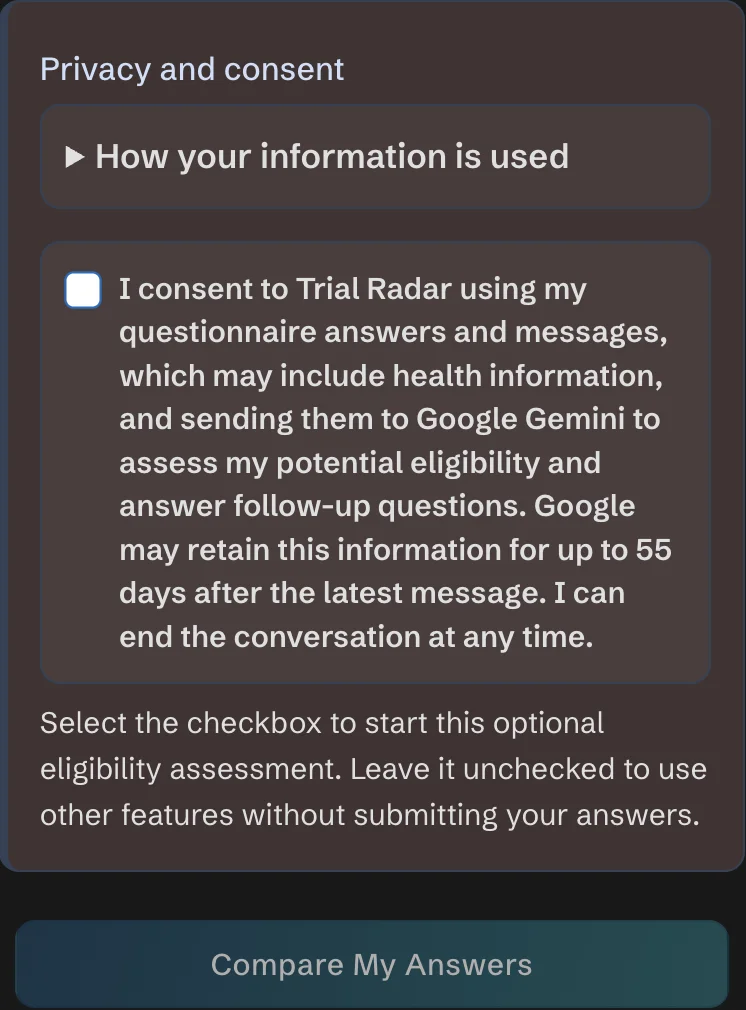
- An explicit, revocable consent scope for each conversation and study; nothing health-related is processed before it.
- Consented turns run only on Google Gemini — no cross-provider fallback, no tools.
- An answer-free consent receipt, kept 62 days: proof that consent happened, with no answers or health information in it.
- End revokes future use first, then requests deletion of the provider-side conversation; a scheduled worker enforces the retention windows.
- Product analytics events are rebuilt from a field allowlist that has no place for AI prompts, AI answers or eligibility answers.
- The Privacy Policy sets out the GDPR Article 9(2)(a) explicit-consent basis for this workflow.
The thread through every world
Complex evidence, cited and understood.
Clinical Trial Radar turns registry records, peer-reviewed literature and FDA data into accessible understanding — so people bring better questions to the professionals who make the decisions.
iOS & Android apps coming soon
Trial Radar explains eligibility criteria in plain language and helps you prepare questions. It does not determine whether you qualify — only the study team can do that.
Trial Radar is an information and education tool. It does not provide medical or investment advice, diagnose conditions, or enroll anyone in a study. AI responses can be inaccurate or incomplete; always check the original study record and talk with a qualified healthcare professional before making any medical or trial-participation decision.